MainFrames.Com

 Are Mainframes making a come back?

 Home SiteMap Email


Big Iron

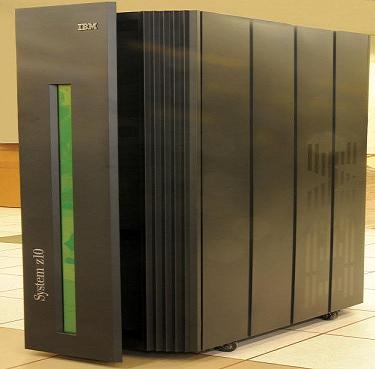
Mainframes (often colloquially referred to as Big Iron) are computers used mainly by large organizations for critical applications, typically bulk data processing such as census, industry and consumer statistics, ERP, and financial transaction processing. The term originated during the early years of computing and referred to the large mechanical assembly that held the central processor and input/output complex.[citation needed] Later the term was used to distinguish high-end commercial machines from less powerful units which were often contained in smaller packages. Today, this term refers primarily to IBM System z9 mainframes, the lineal descendants of the System/360, but it is also used for the lineal descendents of the Burroughs large systems and the UNIVAC 1100/2200 series mainframes

Modern mainframe computers have abilities not so much defined by their single task computational speed (flops or clock rate) as by their redundant internal engineering and resulting high reliability and security, extensive input-output facilities, and strict backward compatibility for older software. These machines often run for years without interruption, with repairs taking place during normal operation. They are defined by high availability, one of the main reasons for their longevity, as they are used in applications where downtime would be costly or catastrophic. The term Reliability, Availability and Serviceability (RAS) is a defining characteristic of mainframe computers.

Characteristics of mainframes

Nearly all mainframes have the ability to run (or "host") multiple operating systems and thereby operate not as a single computer but as a number of virtual machines. In this role, a single mainframe can replace dozens or even hundreds of smaller servers, reducing management and administrative costs while providing greatly improved scalability and reliability. Mainframes can add system capacity nondisruptively and granularly. Modern mainframes, notably the IBM zSeries and System z9 servers, offer three levels of virtualization: logical partitions (LPARs, via the PR/SM facility), virtual machines (via the z/VM operating system), and through its operating systems (notably z/OS with its key-protected address spaces and sophisticated goal-oriented workload scheduling, but also Linux and Java).

Mainframes are designed to handle very high volume input and output (I/O). Since the mid-1960's, mainframe designs have included several subsidiary computers (called channels or peripheral processors) which manage the I/O devices, leaving the CPU free to deal only with high-speed memory. It is common in mainframe shops to deal with massive databases and files. Giga-record or tera-record files are not unusual. Compared to a typical PC, mainframes commonly have hundreds to thousands of times as much data storage online, and can access it much faster.

Mainframe return on investment (ROI), like any other computing platform, is dependent on its ability to scale, support mixed workloads, reduce labor costs, deliver uninterrupted service for critical business applications, and several other risk-adjusted cost factors. Some argue that the modern mainframe is not cost-effective. Sun Microsystems, Hewlett-Packard, and Dell unsurprisingly take that view at least at times, and so do some independent analysts. However, the general consensus (held by Gartner and other independent analysts) is that the modern mainframe often has unique value and superior cost-effectiveness, especially for large scale enterprise computing. In fact, Hewlett-Packard also continues to manufacture its own mainframe, the NonStop system originally created by Tandem. Logical partitioning is now found in many high-end UNIX-based servers, and many vendors are promoting virtualization technologies, in many ways validating the mainframe's design accomplishments.

Mainframes also have unique execution integrity characteristics for fault tolerant computing. System z9 servers execute each instruction twice, compare results, and shift workloads "in flight" to functioning processors, including spares, without any impact to applications or users. This feature, also found in HP's NonStop systems, is known as lock-stepping, because both processors take their "steps" (i.e. instructions) together. Not all applications absolutely need the assured integrity that these systems provide, but many do, such as financial transaction processing.

From Wikipedia, the free encyclopedia

Disclaimer

Copyright / Trademarks