 Contact Us | Sitemap |
||||
What is a "Mainframe"?by Lance H. Vaughan
Having read John Campbell's "What is a Mainframe", and having been asked this question myself many times I would like to propose a more illuminating definition. First, however, some very brief biographical info. I first became interested in computing machines as a teenager. In those days the 2nd generation was rapidly drawing to a close and System/360 was about to change the computing landscape. My first programming experience was in high school, where my class had access to a very fast IBM 7094-II (and before you ask, no, my high school did not have its own 7094; we were allowed limited use of one of MIT's systems). In college I majored in math, primarily because computer science as a major was still about 4 years in the future. Nevertheless, my first love has always been computing machines, and I have invested a lifetime of study and labor in this industry. I have worked with all platforms except vector processing based supercomputers. My favorite has always been, and remains to this day, the mainframe. One might suppose that it would be easy to define a mainframe, but such is not the case. Some definitions are so broad that they include all computing platforms. Others seek to concentrate on some particular aspect of mainframe computing (such as the operating systems which run on a mainframe) and declare that a mainframe is that which runs or supports this computing aspect. This latter definition suffers from two problems: 1) it is completely unenlightening; and 2) it is misleading. For example, the FLEX/ES simulator allows one to run OS/390, VM, and VSE/ESA on a fast Intel processor. Yet most people who have worked with both classes of machine would intuitively consider the Intel PC to be the opposite of a mainframe. Moreover, in the debate between client/server oriented computing, and mainframe based solutions, the inability to clearly define the latter has cost more than one data center its mainframe. The "new paradigm" proclaimed that a clustering of small, limited architecture machines, interconnected by elaborate topologies, was the wave of the future. Lost to a nontechnical senior management was the fact that in implementing this new computational model they were at the same time eliminating the most powerful, comprehensive, and sophisticated class of computing platforms ever brought to the marketplace. So what is a mainframe? In order to answer this question I sat down one weekend and reviewed the history of mainframe computing, concentrating on those elements that are unique to the mainframe world. The result of this effort was the following definition, which has the dual advantages of being both concise and precise. It also invites elaboration and serves as the starting point for an in depth discussion of the issues it raises: "A mainframe is a continually evolving general purpose
computing
platform incorporating in it architectural definition the essential
functionality required by its target applications."
During much of the first 20 years of the modern mainframe era (which began on April 7, 1964) individual models of the mainframe line were targeted by competitive systems heavily optimized to provide a superior price/performance product within a well defined niche market. As the mainframe evolved through product refresh cycles and new product announcements, the niche advantage offered by these special purpose competitors was marginalized, and their ability to compete in a market that demanded an ever greater general purpose capability was simply overwhelmed. The most critical defining element of the mainframe paradigm is that the solutions it provides are implemented primarily in hardware, including microcode, an approach (contrary to what many users of other platforms might imagine) that is truly unique to the mainframe world. From the early RPQs of the 360 era, to the numerous "assists" of the primary 370 era, to the full blown architectural enhancements of the late 370 and 390 periods the mainframe has been a hardware test bed of unmatched scope and versatility. By way of comparison, you may recall that a few years ago Intel added a half dozen instructions to its line of Pentium processors to facilitate graphics processing. Their announcement took a certain pride in noting that this was the first change to the PC's instruction set in the previous 13 years! One of the most striking elements of mainframe computing, when viewed over time, is the extent to which the architecture changes to accommodate user requirements. One of the early selling points of System/360 was its stand-alone emulation of 2nd generation systems. By the time System/370 came along, stand-alone emulation was replaced by integrated emulation, a critical user requirement. Hundreds of RPQs have been made available over the years to satisfy one user requirement or another. Some of these solutions were limited time offerings; others became a permanent part of the architecture. One of my favorites from the former group was the High Accuracy Arithmetic Facility (HAAF) available on the IBM 4361. This mainframe, marketed as a supermini, was targeted at university math and physics departments. With installation of the HAAF one could do floating point arithmetic without carrying a characteristic in the floating point number. Moreover, all errors introduced by fraction (mantissa) shifting were eliminated. This facility permitted floating point arithmetic to be analyzed for accuracy under a wide range of computational conditions, a stunning capability for the math and physics users.In summary, the essential characteristics of a mainframe are: rapid and continuing evolution, general purpose orientation, hardware implemented solutions, and the criticality of user input to all of these processes. by Lance H. Vaughan Reprinted here with his permission |
Sponsored by 
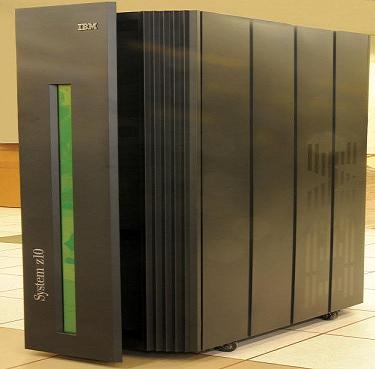 IBM z10 |
|||

| ||||
 Software Diversified Services, Minneapolis, MN USA